Thursday, 25 June 2009

On Conrad Veidt and my Grandfather

Women fight for Conrad Veidt
My Grandfather, who is to turn 89 next month, said a very strange thing to me today; we were discussing silent and early films. I asked him, "Do you know of the actor, Conrad Veidt?", as I was inspired to mention The Man who Laughs.

"Oh yeah," he says, "I've seen him." "In which film?" I ask. "In person," he replies.

Obviously my reaction was, Whaaaaaaaaa--t? But it turns out he's seen many famous actors and actresses, including Conrad Veidt and Mary Pickford (and many others whom I've forgotten their names...). When he was young, around the ages of 4-7, his mother would take him to see films every weekend, and so he became acquainted with silent films. And as he was living in bustling, busy London, he managed to see some of these actors in person.

Funny, isn't it?

Tuesday, 23 June 2009

The Cabinet of Dr Caligari (Das Cabinet des Dr Caligari) - 1920 - Robert Wiene

Insanity summed up in one picture
I have seen many, many strange films in my time. But of all of them, The Cabinet of Dr Caligari is by far the strangest. And yet at the same time, it makes perfect sense.

Everything about the film is dream-like and disorientated. As soon as Francis begins to narrate the story, the scenery turns into what is only a mess to the eye, where buildings bend and twist, are at impossible angles, and are exaggerated; small buildings look too small to live in and large buildings tower above the rest, pathways are either dead straight or ludicrously bendy, bridges look impossible to walk over, the kind of thing you can only imagine. You can only admire the effort put into making the backdrop.

It is difficult to give a 'short summary' of the film; too much goes on, and too much revealed information may leave spoilers. But I shall say: The story is of a travelling fair that comes to a mountain village, where one of the attractions is 'The Cabinet of Dr Caligari' - which features a somnambulist (a sleepwalker), who can answer any question posed to him. Alan, Francis' friend, bravely asks when he will die. The answer shocks the audience - he will not live to see tomorrow.

It must be remarked at how cleverly the film has been made. One scene features a murder - no prizes for guessing who the victim is - which is exceedingly brutal, yet we see not a thing. What we see, instead, is the shadows of the murder taking place - but it is so explicit, if short, that it still shocks modern audiences. That's the beauty of German expressionism.

Also my admiration for Conrad Veidt, who plays Cesare the somnambulist, went up considerably after watching this film. His part may be limited, but he plays it very well, and stretches his part to make the most of it, and show the world what he can do. It is like in The Man who Laughs, where, although the part only requires him to smile all the time he is on screen, he conveys so many forms of emotion, that I would be very surprised if any other actor can perform to, or better than, his standard of acting ability.

In short - this film is an excellent example of German expressionism at its best. Furthermore, it is an extremely notable part of history, as it is the first film to include a 'twist in the tale' - and a clever and intriguing one it is.Werner Kraus - don't look behind you

Friday, 19 June 2009

M - 1931 - Fritz Lang

The marked murderer

There is something always intriguing about villains in films and books. And one of the most unknown, yet omnipresent villains in a single film has to be Hans Beckert, from Fritz Lang's M.

'Wer ist der Kindermörder?' is the question repeated on everybody's lips; the citizens, the police, the underworld, even the audience can't help but gaze helplessly at the screen, waiting for an answer. The suspense is in the absence of a lead. This is the main character - the central figure, but who is he? The only clue we can get is the opening scene, which imprints itself indefinately onto the minds of all those who see it.
A young girl, on her way home from school, bouncing a ball along the pavement, carefree, a simple routine. But it is interrupted by a voice, which belongs only to a shadow cast onto a poster, which implores for information about a recent murder of a child.
"Du hast aber einen schönen Ball!... Wie heißt du denn?" "Elsie Beckmann!"
("You have a very pretty ball!... What's your name, then?")
We then see this man buy a balloon for the girl, and takes her away, side-by-side, like father and daughter. Nothing more is seen of the girl, or of the murderer (until much later), except for a few artistic camera shots. An anxious mother, a place set at the table, where is she? ... an empty stairwell, an empty street, and then a bush - Elsie's ball rolls out from behind the bush, and we see the balloon, given to her, struggle against some telephone wires. Fade to black.
Why should you see this film? It is impressive in every single way. Everything is done purposefully, not just that the shot 'looked good' just by chance. We're dealing with Fritz Lang, one of the most famous directors in Germany, if not, the world. He brought us Metropolis four years before M. Metropolis was a flop at the time; it was expensive, long, and there were several other different complaints. M was Fritz Lang's first sound film and it was his saviour, and consequently, it became his favourite film which he had directed.
The best scene in this film, and undoubtably the best scene in cinematic history, is the last scene, the 'Kangaroo court' scene. Peter Lorre takes on the strenuous role of psychotic killer, and plead to an audience, why he must kill, how he must kill... There is no over-acting, and there is no 'talentless' acting; Peter Lorre executes the part perfectly, flooding his words and actions with emotion.
And to make the film even more perfect, there is no background music, at all. Some may claim this is a bad thing, but I do not agree; it gets rid of the barrier between fiction and truth; you are IN the film. Is this reality, what I see on the screen before me? And yet the actions are so real, how can it be fiction?
I highly recommend this film to anyone who enjoys complex storylines, within an overall basic plot. Fritz Lang's style is inimitable, yet sadly it has been re-made since, in 1951, which was not rated highly. Yet the original, rated highly by many, is something to be seen.
Who's behind that door? -- they're coming to get you

Saturday, 13 June 2009

Calling all silent film buffs

My new blog appears to have turned into a silent/black and white film haven. Very well, now it has a purpose.

Calling all film buffs: Who knows anything about silent films? Put your interests to purpose: Identify some of these films. http://www.silentera.com/info/index.html (Follow the links)

Considering my main interest in german silents are restricted mainly to expressionist films, such a task is not for me. Plus, I have exams to do, so I have no time for it XP

Friday, 12 June 2009

Freaks, 1932, Tod Browning

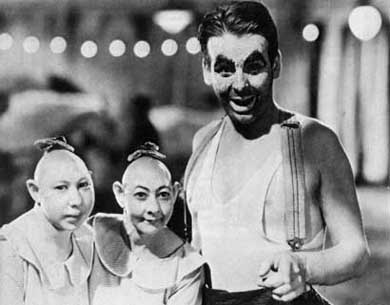
a 'normal' with two pin-heads It appears, to me, that the 1930s was the decade of notable horror films. In 1931, we had both Dr Jekyll and Mr Hyde and Dracula, in 1932 we had The Mummy and Vampyr, all of these being some of the most well-known films. But one of the most notorious, perhaps imfamous films of this decade is perhaps Freaks.
Directed by Tod Browning, who also directed Dracula the previous year, Freaks is undoubtedly one of those films which stay on your mind. But that may also be because it is inimitable.
The bizarre thing about Freaks is that the main storyline is like any other. It is very simple: a wealthy man falls in love with a beautiful woman, who is, in turn, in love with another man. The woman marries the wealthy man for his money, and tries to poison her new husband so her lover and herself can keep his money. Sounds ordinary, huh? Now just replace the wealthy man with a wealthy midget, and you have Freaks.
Tod Browning directs the film very cleverly so as not to exploit the 'freaks' in his film. And of these there are many:

  • a hermaphrodite
  • a woman with no arms
  • a man with no legs
  • a bearded lady
  • four 'pin-heads' (microcephalics)
  • a 'human-skeleton'
  • two midgets (in fact, brother and sister but in the film they play as fiancés)
  • a dwarf
  • conjoined twins
  • two bird-people (suffering from Virchow-Seckel syndrome)
  • a living torso (not just a, but the, the famous Prince Randian)

...as well as (at least) one other character, but unfortunately, due to loss of a lot of footage of the film, not a lot is known about them. In fact, quite a lot of the film is now lost, including footage of Hercules, the lover, singing in soprano after the freaks took their revenge after he and Cleopatra, the woman, hurt and humiliated Hans, the midget. You can guess what they did to him. What they did to Cleopatra is well-known, however. But I can assure you it's all just fancy make-up and camera trickery for these. Yet the freaks are real. Very real.

It is a film that simply shows that people are still human, no matter what their appearance. The pin-heads, who are mentally retarded due to their condition, cannot speak compltetly coherently (on the film, at least), although they can speak, yet show a range of emotions. Schlitze, for example, shows joy and flattery after one of the 'normals' compliments him on his dress (which he wore due to incontinence), and promises to buy him a hat with a feather on it. Two other pin-heads come along, and the 'normal' says he'll buy them a hat with an even bigger feather on it. At this Schlitze shows a sort of playful-jealousy - jealousy being a complex emotion.

The freaks are like anyone else. They feel the same way as anyone else. They think the same way. But, because of their appearance, they are outcasts -- but look out for each other. There are only a few 'normal' characters in the film who consider the freaks to be like them, and we, the audience, are forced to believe the same thing.

It is a film, whose message is still relavent today. Despite the age, it is still a shocking film, however I do not count it to be a 'horror' film. At the start, one may well be repulsed by these unusual sights, but the audience quickly learns that there is nothing to be repulsed at; they may appear grotesque but they are not jumping out and screaming at the camera like in the traditional sense of 'horror'. Yet the true horror appears when Cleopatra and Hercules insult the freaks, especially through marrying Hans, as she shows him up as dreaming to be 'like one of them'.

It is one of those films which have to be seen. And I would recommend it to be shown in schools, to make people realise that these people are not to be laughed at due to their appearance. In a way, it is a shame that through medical advances these people do not exist in great numbers today, so those who are 'different' are shown up even more. But I am glad that Tod Browning made Freaks, a film banned for decades in many countries, to show that these people did exist, and there's no denying it.the cast of Freaks